
October 24, 2009
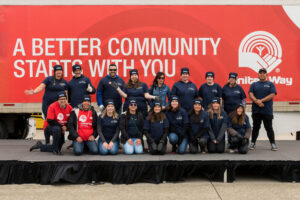
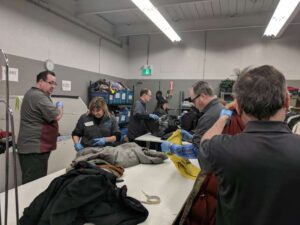
On Saturday, October 24, 2009, 17 members of the City of Winnipeg Water and Waste Department assembled at the Main Street Project (MSP), 75 Martha Street, Winnipeg, to feed supper to approximately 250 of their clients. Along with the 17 staff who served at the MSP, this undertaking was the culmination of the efforts of many volunteers from across the Department.
According to their website (2009), the Main Street Project has been serving the needs of Winnipeg’s most vulnerable residents for more than 30 years. By providing emergency shelter and food services, a drug and alcohol detoxification unit, on site counselling, transitional housing, and a range of other critical services, they work to support their clients’ basic needs, while ensuring the opportunity to make real choices, and meaningful progress, each and every day.
As part of their services, the MSP counsels approximately 28 people battling various addictions who reside in the detoxification unit. They also counsel approximately 28 people residing in transitional housing unit, also known as the Mainstay Residence. These people have kicked their addictions and are trying to transition themselves back into society – get a job, find a place to live. They also run a drop-in centre for homeless street people where they serve soup on a daily basis and offer a place to sleep at night. Approximately 200 to 250 people use this service. The people who frequent the drop-in centre are usually intoxicated and are generally turned away by the other service organizations in the area.
From time-to-time various organizations volunteer to give the staff of the MSP a break by preparing and feeding a suppertime meal. Before a group is given a date there is a number of obligations that the group must agree to. They are responsible to establish the menu, prepare the meal (dessert included) and transport it to 75 Martha Street. The meal should be wholesome, free of food allergies and easy to serve. For our meal, we decided to serve a fruit drink, beef stew, bread (with margarine), fruit cocktail, bananas and Halloween candies. The meal should be prepared off site. Access to the facility, particularly the kitchen, is not available until after 2 p.m. and serving starts at 4 p.m. There is not enough time to prepare a meal on site for approximately 300 people in less than two hours. The group is also responsible to bring everything they require to help them serve the meal with them such as plastic glasses for the drinks, disposable bowls and cutlery, napkins and so on. Finally, clean up after the meal is over is required.
The MSP recommended that we prepare enough food to feed approximately 300 people. This included the homeless drop-in centre, people in the detoxification unit and also in the Mainstay residence. We would not have to deal with the drunk tank. We decided to base everything on 320 people to be safe. We calculated that we needed 180 litres of stew to feed 320 people. We also decided the best way to prepare such a large amount would be to divide the total quantity up amongst a number of volunteers, and then combine it once we got to the MSP. To ensure some consistency and to eliminate the threat of food allergies, we decided to supply a recipe to the volunteers and ask them to stick to it. Fortunately one of our volunteers prided himself as a “chef” and prepared an excellent recipe for us to use. He even put it into a spreadsheet that had the ability to calculate the exact quantity of ingredients required depending on the number of cups we wanted to make. At the end of the day, we had 18 volunteers who agreed to make 10 litres of stew each (some volunteers agreed to make 20 litres, some teamed up together).
To meet our other obligations, we had a number of hurdles to get over. How do we get 180+ litres of stew, prepared by volunteers spread across the City to 75 Martha Street? What are we going to feed these people along with the stew? Besides food, what else do we need to bring with us and where can we purchase all this stuff in large quantities? How do we pay for it all?
To handle the transportation of the stew, we established a “Transportation” committee. They took on the responsibility for organizing the picking up and dropping off of the stew. To determine what we needed and what our total costs would be, we set up a “Shopping” committee. This committee was also responsible for purchasing everything and getting it to the MSP. To give you an idea of magnitude of what we had to buy, we purchased: 44 loaves of white bread (which had to be buttered when we got to the MSP – hence the “Buttering” committee, 160 pounds of bananas, 350 – 16 oz Styrofoam bowls, 17 2.8 litre cans of fruit salad, and so on.
To cover some of our costs, we asked the volunteers preparing the stew to cover their costs out of their own pockets. Fortunately, they all agreed. As for covering the rest of the costs, it was obvious we were going to have to solicit donations and/or conduct some fundraising. Our total expenses (excluding stew) came to $570, all of which was covered by the generous support of the staff of the Department. It should also be mentioned that the volunteers who agreed to cook stew for us agreed to cover the costs out of their own pockets, somewhere in the range of $30 – an extremely generous gesture.
The day was declared a great success. The staff of the Water and Waste Department should be extremely proud of their generous support. The experience was considered to be very enlightening and rewarding for all those directly involved – either cooking or serving. The staff of the MSP very impressed with how organized we were and expressed deep appreciation for all our efforts, thoughtfulness, and caring. Even the patrons that we served were very appreciative. I would like to express my personal appreciation and heartfelt thanks to all the volunteers who made this all work.
Written by Ken Dalton, Lead Organizer of Event, edited by Tracy
Tracy’s Comments:
I was the Lead for the Shopping Committee and Food Coordinator which meant I was responsible for pricing and picking up goods. This seemed like an enormous task to provide only one hot meal but I knew this may be the only meal some of the individuals may receive for the day. But, what I didn’t realize until the day we were serving the meals to the patrons, that the social contact was just as important as the food itself. All of them were very grateful and I was sincerely thanked every time I distributed a meal and some of them even engaged in minor conversations. I felt that some of them did not even want to see us leave, even after all the meals were distributed and eaten. Sadly, about 1700 people are homeless in our city on any given night.